Introduction
N2AFRICA is a large scale, science-based “research-in-development” project focused on putting nitrogen fixation to work for smallholder farmers growing legume crops in Africa.
Legumes bring atmospheric nitrogen into the crops and the soil through a symbiosis with Rhizobium bacteria, and they are an important source of protein in a healthy diet. Enhanced productivity of legumes thereby contributes to improvements in soil fertility, household nutrition and income. N2Africa enables African smallholder farmers to reap these benefits through the implementation of effective production technologies including inoculants and fertilizers.
N2Africa links scientific research with capacity building (from farmers to traders, development workers in extension and NGOs), educating MSc and PhD candidates, women’s empowerment, and access to input-output markets through Public-Private Partnerships. A strong network ensures continuous and independent improvement of technologies and market access.
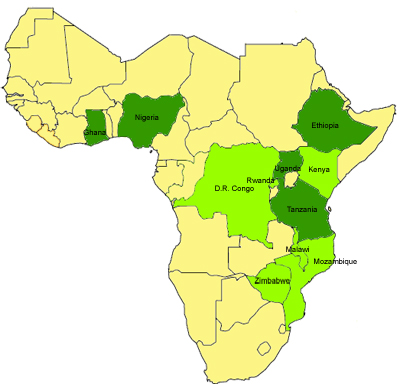
With funding from the Bill & Melinda Gates Foundation, N2Africa has been active since 2013 in Ethiopia, Tanzania and Uganda, and since 2009 in DRCongo, Ghana, Kenya, Malawi, Mozambique, Nigeria, Rwanda and Zimbabwe. Focal legume crops are common bean, chickpea, cowpea, faba bean, groundnut and soyabean.
From best-bets to best-fits
The performance of a grain legume and the associated amount of nitrogen fixed depend on the interaction between the genotype of the legume, the genotype of the rhizobia, the environment and the management of the crop and field: (GL× GR) × E × M in short.
N2Africa selects and tests good-potential legume genotypes, does research to identify the best matching rhizobia strains and tries to optimize the management of legume fields. Testing of legume technologies by large numbers of farmers allows for tailoring and adapting legume technologies to specific sites and specific farmers. This results in a set of best-fit principles and options for each project area.
Impact Direct beneficiaries of N2Africa are the farming households with increased benefits from biological nitrogen fixation – such as greater food and nutrition security or increased incomes – and the households benefitting from the network that was built to improve access to information, agricultural inputs and markets. By 2017, N2Africa had already reached more than 600,000 smallholder farmers with improved technologies for grain legume production. Other beneficiaries are producers of legume seeds, legume-specific fertilizer mixes and inoculants through an increased demand for their product, as well as agro-dealers trading these products. Development project staff and scientists are exposed to new ways of doing science through the ‘development-to-research’ framework, and hands-on capacity building activities. By working through national systems, training key stakeholders from farmers to traders, development workers in extension and NGOs, and by educating MSc and PhD candidates in each country, we build the capacity that can in the future sustain an independent and continuous improvement of legume production technologies.
|
N2Africa Map Overview : Core countries (dark green), Tier 1 countries (light green). |
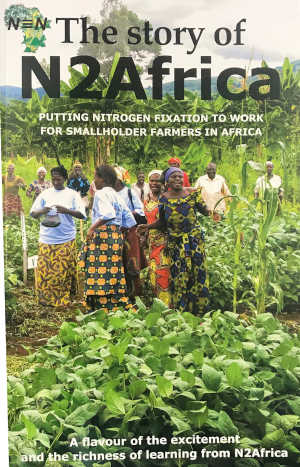 | The Story of N2Africa - an online magazine that provides a flavour of the richness of learning over the past ten years of the project N2Africa: Putting nitrogen fixation to work for smallholder farmers in Africa Please share widely using #N2Africa |
 | Click here to download the N2Africa Final Report of the First Phase. |
Download our newsletter (The Podcaster)

Latest News
| Title | Summary | # | ||||
|---|---|---|---|---|---|---|
| Africa has lost a committed farmers’ champion – Rest in Peace! |
|
3 |